Frequently Asked Questions
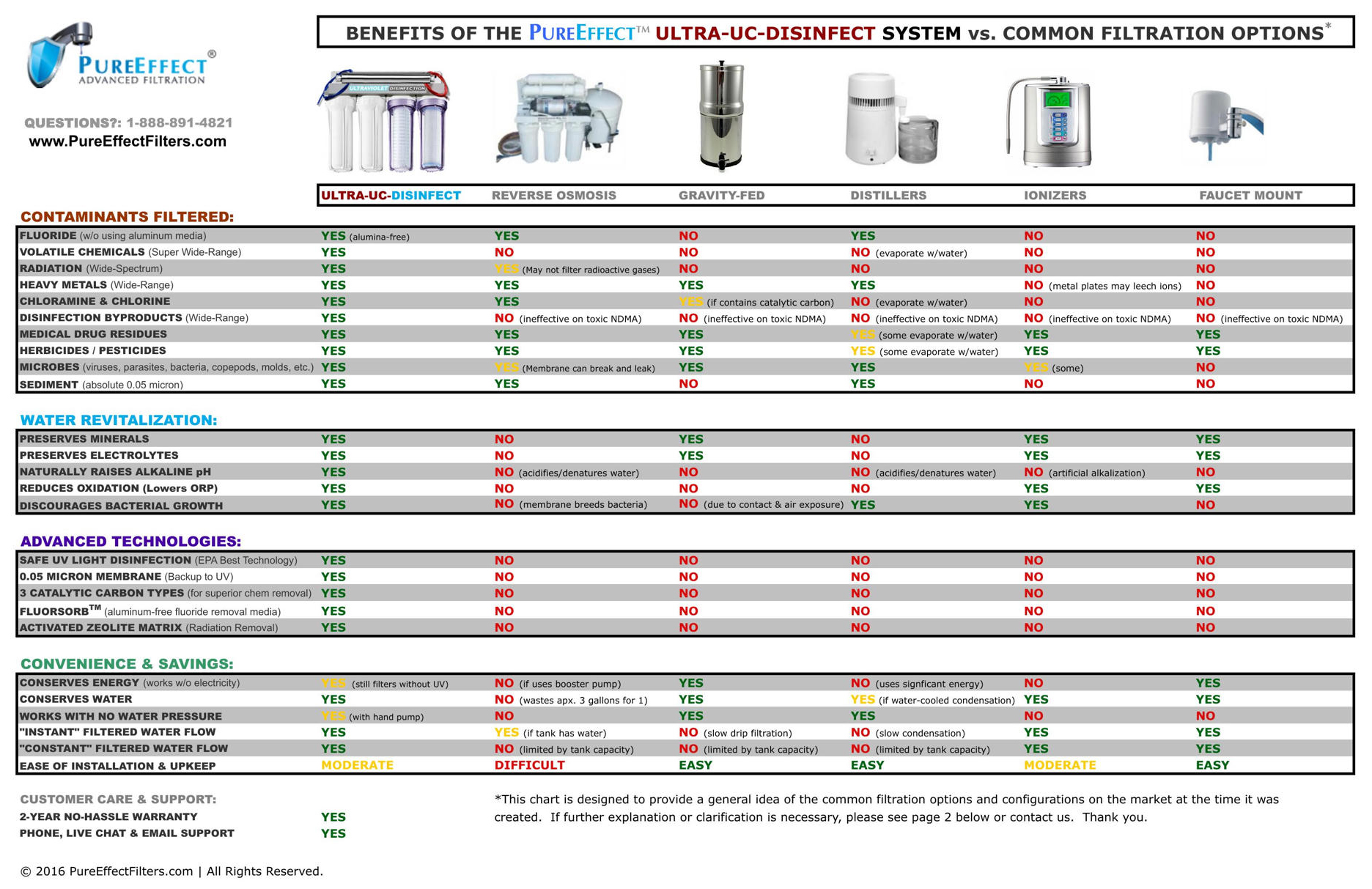
1. What are the main advantages of your system vs. others like reverse osmosis, distillers, etc.?
Our filter systems do much more than just filter, theyy are infact water revitalizers- nourishing & regenerating your water on many levels, they:
- Support a naturally balanced alkaline pH.
- Preserve beneficial minerals/electrolytes which are naturally present in your water.
- Increase waters antioxidant properties by lowering ORP (oxidation potential).
- Effectively filter fluoride, chloramine & cadiation (some of the most difficult contaminants).
- Don't rely on a thin film membrane which can clog, break, leak contaminants and breed bacteria.
- Don't waste water (R.O. systems can waste apx. 1-3 gallons to filter 1).
- Don't store water in a sealed storage tank (which cannot be opened/cleaned and can breed bacteria).
- Don't require electricity (except for UV add-ons), and thus can still provide clean water during power outages.
OUR MOST ADVANCED FILTER ULTRA-UC-DISINFECT vs. OTHER TECHNOLOGIES:
Click chart to open larger PDF image
2. Which of your drinking water systems is best for me / how do they compare?
Click chart to open larger PDF image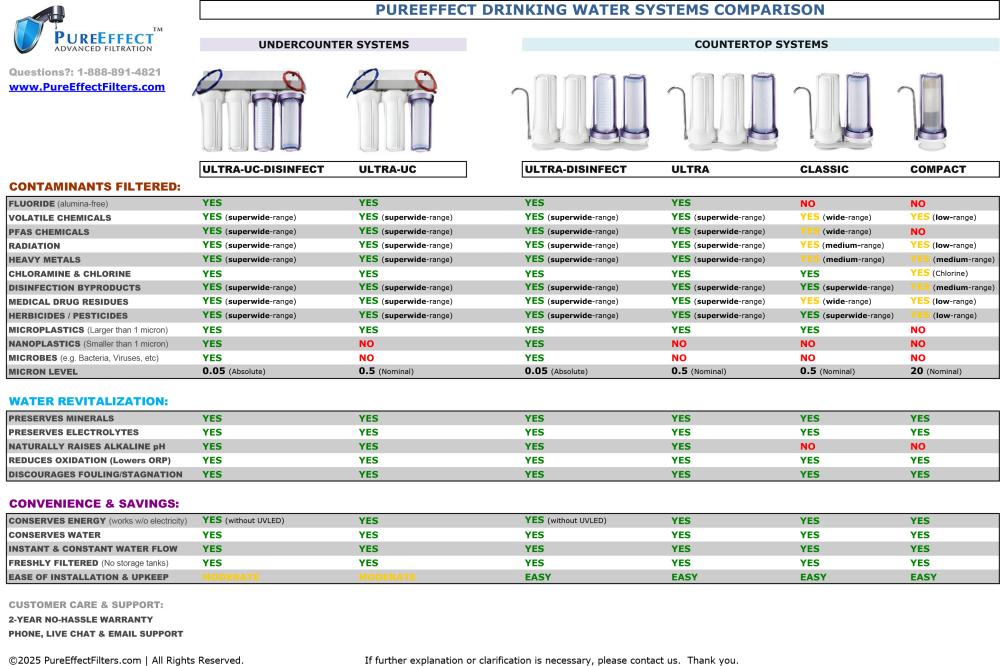
3. How do your filters preserve the beneficial and naturally occurring minerals in the water?
All our filters are designed with specially developed natural media that does not have strong attraction for natural & necessary minerals/electrolytes that are present in your water, as such, our systems won't strip them out. In combination with our advanced filtration process, these minerals neutralize acidic water, help hydration, balance pH making toward alkaline, are crucial for many bodily processes and give the water a fresh and delicious taste, just like nature intended.
A great study from the Czech Republic Institute of Health highlights the importance of minerals in water:
"Awareness of the importance of minerals and other beneficial constituents in drinking water has existed for thousands of years, being mentioned in the Vedas of ancient India. In the book Rig Veda, the properties of good drinking water were described as follows: “Sheetham (cold to touch), Sushihi (clean), Sivam (should have nutritive value, requisite minerals and trace elements), Istham (transparent), Vimalam lahu Shadgunam (its acid base balance [pH balance] should be within normal limits)“ (Sadgir and Vamanrao 2003). That water may contain desirable substances has received less attention in guidelines and regulations, but an increased awareness of the biological value of water has occurred in the past several decades. Full Report."
4. Why is a TDS meter not an accurate measure of your filter systems performance?
A TDS Meter measures Total Dissolved Solids, which primarily includes natural and necessary minerals such as Sodium, Calcium, Magnesium, Potassium, Silica, etc. (without these elements, water would be acidic, corrosive, denatured, less-hydrating andcan leach minerals from the body). As such, our systems are purposely designed to leave these nutrients in the water, hence, a TDS meter will always show a reading higher than 0 when using our filter, as it should.
Furthermore, TDS meters only detect a positive or negative charge, which means, many neutral contaminants (pesticides, ammonia, herbicides, etc.) won't be detected, neither will it detect larger molecules that fall outside it's detection field; and since a TDS meter doesn't differentiate between beneficial minerals and contaminants, and because minerals make up most of the TDS count, it is a misleading test for drinking water. To properly test your water, you would need to test for specific contaminants in question.
Any filter company that claims water with 0 TDS is the optimal filtration result, is in our view, not aware of, or is disregarding the proper chemistry of drinking water. For more on this subject, please see question #3 above regarding the importance of minerals/electrolytes in water.
5. If I have a whole house filter, do I still need a separate filter system in the kitchen?
Although a whole house filter will significantly improve the quality of your water, it cleans the water BEFORE it goes into your homes plumbing system, the filtered water can then pick up contaminants from the hoses, pipes, water heater internals, etc. Our countertop or undercounter systems for the kitchen will filter your water directly AFTER the plumbing system, and at a much slower flow rate, which results in an even higher % of contaminant removal due to greater contact time with the filtration media. So for drinking/cooking water, our undercounter/countertop systems are the way to go.
6. How do your water filtration systems compare to the high-priced water ionizer machines?
Our systems primary focus is to clean your water of a very wide range of contaminants, something water ionizers aren't designed to do very well since their main purpose is to artificially ionize or alkalize your water using electricity and metal plates.
Further, water ionizers have been a subject of controversy regarding their benefits vs. risks due to the overly alkaline pH they produce using artificial means -by changing the electrical charge of the water and not by using actual alkaline minerals. As such, the pH from an ionizer is unstable, it begins to fizzle out and drop off after you pour the cup. PureEffect systems use a stable, gentle and natural approach to balance alkaline pH within the drinking water range as found in nature (apx. 7.5 - 8.5).
The pH increase is a combined effect of our systems neutralizing acids (with trace natural calcium), removing acidic contaminants such as: fluorosilicic acid, disinfection byproducts e.g. (haloacetic acids), PFAS and others, and by preserving the alkaline minerals already present in your water supply.
Our process is similar to how it occurs in nature when water flows over mineral-rich riverbeds. And unlike ionizers our systems don't require electricity.
7. What is your position on the recent hype with hydrogen-infusing water machines?
As with any new technology, especially ones which involve drinking water and are promoted by hype and anecdotal data (poor quality and/or biased studies, hearsay testimonies, etc.) as their main points of sale, we advise being cautious and do not feel confident about supporting or implementing it in our product line.
Our professional opinion after nearly two decades in the water treatment industry and seeing various similar fads come and go, is that these machines will have a similar fate as the artificial water ionizers, they will fizzle out as the hype settles down and people realize that the less we mess with and deviate from natural principles of water, the better.
Until credible scientific research (e.g. randomized, placebo-controlled, double-blind crossover studies) can verify its short and long term safety and efficacy, we err on the side of caution. However, if you still wish to use such a machine and want the water properly filtered before it, then you may be able to connect our system before the hydrogen machine.
8. Why does my filtered water appear cloudy?
Cloudiness can be the result of 2 harmless causes.
1. When brand new, the cartridges need to adapt for apx. 1-2 weeks; during this period the natural mineral fines from the cartridges can cause cloudiness.
2. If the cloudiness in your cup goes away within apx. 1 minute after you pour it, it's the result of microscopic oxygen bubbles and actually help make the water even fresher. In both cases, the effects are natural, harmless and temporary.
9. Why did my filter water stop flowing?
The most common reason for this is if your leak-stopper device got triggered and shut off the flow of water. First, determine and address the cause of the leak under the sink and then replace the leak-detection tablet in the leak-stopper as per instructions (check which generation leak-stopper you have by clicking here).
For Gen 1 instructions: Click Here.
For Gen 2 instructions: Click Here.
10. Why is my filter system beeping?
There are 2 reasons you can hear a beeping sound from your filter system:
1. If you have our Digital Gallon-Meter take a look at the display while your filter is turned on to determine the cause of the alarm. It makes a beeping sound if you have 30 gallons (or less) and/or 7 days (or less) remaining of filter cartridge life. Also, if you see a little battery icon, it means the (2) AA batteries need to be replaced.
2. If you have our DISINFECT Series Water Filter with UV Light add-on, please check the power adapter that plugs into the outlet if you see a red light on it, it means the UV has a malfunction and is not currently disinfecting the water (2nd Gen. LED version of this system will have the red light right on the UV system itself). Contact us for troubleshooting assistance.
11. I'm not going to be using my system for more than 2 weeks, how can I properly store the cartridges?
a. Shut off the water supply to the unit and open the filter faucet to release pressure (for undercounter models).
b. Remove cartridges and stand them upright for about 20 minutes in a dish/tray to collect the draining water.
c. Place each cartridge into an individual zip-lock bag, seal it and place into the fridge (DO NOT freeze).
When you return and place the cartridges back into the unit, run the system for 5 minutes to refresh the cartridges. *It is also a good idea to shut off the main water supply to your home as a safety precaution against any water issues while you're away.
12. How does your FluorSorb-MAX™ fluoride removal filter differ from activated alumina often found in other filters?
We do not use activated alumina (aka Aluminum Oxide) in our filter systems because it is a synthetic oxidized form of the metal aluminum, and is a cheaper and much less effective material with potential for leaching aluminum ions back into the water, it also requires acidic water pH and impractically low flow rates to be effective.
The FluorSorb-MAX™ media is our proprietary, all natural, alumina-free, calcium-carbon-phosphate based media which interacts with the fluoride ion and attracts it to its surface and pore structures. Side by Side Comparison testing has shown that FluorSorb-MAX™ is much more thorough and consistently removes apx. 45% more fluoride across a wider pH range and higher flow rates than Activated Alumina.
FluorSorb-MAX™ removed fluoride down below detectable levels as verified by independent lab testing.
13. How can I quickly check how much fluoride my county adds to my drinking water?
There are 2 simple ways to check this:
A). Ask AI: e.g. "I live in [city/state/zip]. Based on the latest official city data and water quality report confirm how much, if any, fluoride is being added to my water and provide the link to the official source."
B). Check the CDC Database: Click Here
14. What is ORP and how do your filters increase the antioxidant potential of water?
ORP is a measurement that shows whether water is more likely to cause oxidation (like rust or browning) or less likely to.
Our filters use special media that lowers this (by apx. 25% in our testing), making the water less oxidizing. That’s what is meant by increase in antioxidant potential.
15. What % of heavy metals, radiation, fluoride and chloramine can your filters remove from the water?
Heavy Metals:
98% | According to the manufacturer of the patented KDF55 Media which we use.
Fluoride:
>95%* (removed down to non-detectable levels in independent testing). *Removal % is dependent on pH, Contact Time, Flow Rate and Fluoride Concentration, and is accomplished using our proprietary FluorSorb-MAXTM cartridge, which is made of activated-carbon bonded with a natural calcium substrate and super-heated to nearly 600oC. It consistently outperformed the commonly used synthetic Activated Alumina media by removing apx. 50% more fluoride.
Internal testing: EPA Method 340.2 established removal rates of over 95%: 2.2mg/L (tap) down to 0.1mg/L (filtered)
Independent testing: EPA Method 300.0 established removal rates of over 94%: 0.71mg/L (tap) down to <0.05mg/L (filtered)
*Most cities keep their fluoride levels around 0.7mg/L as per Federal Recommendations.
Chloramine:
>99% Due to our latest innovation: The SuperBlockTM Dual-Catalytic Carbon Technology, which is a proprietary combination of 2 unique catalytic carbons in 1 single 0.5 micron carbon block.
Radiation:
>99% Uranium removal: A recent well water analysis of a NH customer showed a Uranium count of 66.4 pCi/L (more than 3x the EPA limit of 20pCi/L). After installing our filtration system, follow up testing showed Uranium count to be less than 0.67 pCi/L, resulting in the effective removal of over 99% of this contaminant.
For other radioisotopes, e.g. Cesium-137/134, etc.: Based upon the specific scientific properties of the Zeolite in our AntiRad-Plus Cartridge, by knowing the atomic weight of the radioisotope, the PPM concentration in the water, and the specific cation exchange capacity per gram of Zeolite, we are able to calculate that it can remove over 115ppm of Radioactive Cesium from over 1000 gallons of water. 115ppm is a high concentration. We use the same Nuclear-Grade Zeolite that Nuclear Facilities have been using for over 40 years.
16. How does the filtered water taste?
We feel that our customers' input says it best, here are a few quotes from their reviews:
"In my youth I occasionally hiked along alpine meadows in Utah's Uinta mountains drinking pristine snow-melt milky appearing water. Seldom since have I re-encountered that taste in water until now" — by: Mike
"I used to enjoy spring water on my organic farm years ago. This filtered water has that bright pure taste." — by: Yeoman Gardener
"The water it produces is crisp, clean, and tastes how water should" — by: Marine 03
"The water (after initial flushing) was unbelievably revitalized and pure tasting." — by: PureH2OFan
(Additional reviews can be read here)
17. Since your countertop filters connect to my faucet, how do I switch between filtered and unfiltered water?
Our special diverter valve screws onto the thread of your faucet and allows you to redirect the water to the filter and back to non-filtered flow on-demand by a flip of a handle.
18. How long do the cartridges last?
For our 2, 3 and 4 chamber systems, we recommend to change the cartridges every 500 gallons or 12 months, whichever comes first. Our digital gallon-meter device can help you keep accurate track. *As a customer, you will receive a 10% discount on replacement filter orders when subscribed to our email list (subscription confirmation is sent after you place an order).
19. Can I run hot water through your filter systems?
No, hot water (120+ degrees Fahrenheit) will not be adequately filtered, can damage the filter system and void warranty. Also, its not possible to run hot water through our undercounter or whole house filters as they connect only to the cold water lines. However, with countertop filters you need to be more careful.
20. What is the best method of determining which contaminants are in my water?
All tap water, unfortunately is contaminated to some extent, even the most natural waters can be contaminated with natural contaminants like hydrogen sulfide (rotten egg smell), uranium (earth leaching), iron, lead, radon, radium, etc. So no water test is the final answer, but they will give you a general idea of your water quality at that moment of testing for those particular contaminants.
Some sources report that there are over 80,000 chemicals used in society today, so it would be nearly impossible to test for them all anyway, and often times if a certain contaminant is not detected during a test, it can still become present in the future, as water quality is always changing. As such, a powerful water filter is not only necessary to deal with existing and known contaminants, but also serves as insurance against potential future contaminants that can appear in the water or untested ones.
Some inexpensive and basic water tests (for: chlorine, heavy metals, pH, pesticides, etc.) can be purchased on Amazon.com and done at home, for more advanced and more accurate tests (Fluoride, Chloramine, VOCs, Pesticides, Radiation, etc.) we recommend using an ISO Certified and EPA Accredited lab such as this one: Click Here. Note: Any water testing labs that also sell water filters or water filter companies that also do lab tests should be avoided in our opinion, as there is a bias, conflict of interest and thus, potential for deception.
21. My faucet has low water pressure, which of your filter systems would suit me best?
Any of our systems should work fine with low water pressure as the cartridge media is designed for low water resistance.
22. Do you offer financing options?
Yes, financing is available to US residents through PayPal® Pay Later (click here to see current promotion). Simply place the desired items in the cart and select "PayLater" as the payment option and you will be re-directed to PayPal's site for final payment processing.
23. Do you make shower filters?
Yes, we make an advanced shower filter which can be seen here.
24. Do you plan to offer gravity or pump filters that can work outdoors?
We have no such plans at this time.
25. I'd like to sell/market your products and would like to know if you have an affiliate program?
Yes, you may signup here.
26. How do I properly cleanse the Ultrafiltration Membrane? (applies only to our 4 chamber DISINFECT systems)
There are 2 acceptable ways to accomplish this: Method 1). Steam (don't boil) it for 30 minutes, then rinse, place into filter and flush the system for a few minutes, or: Method 2). Fully submerge the membrane into 3-5% Hydrogen Peroxide liquid (we recommend to place it in a glass vase and fill it with hydrogen peroxide), ideally every 6-12 months for a period of 12 hours (or 60 minutes if using 10-15% Hydrogen Peroxide). In 12 hours remove the membrane and rinse under warm water, then install it back into your system. Flush the system with cold water for 5 minutes before use.
27. What sort of maintenance is required on the filter units?
Our systems are designed to be simple and easy to care for. With every cartridge change wipe the units inside and out with non-toxic dish soap and rinse with warm water. The spout should be cleaned every 2 weeks using a straw brush and non-toxic dish soap with warm water. The leak-stopper and pressure regulator devices should be replaced every 4 years.
If your question wasn't answered here:
Please ask us using our live chat feature or visit the contact us page.